






how to support your immunity ahead of cold season.
How to Support your Immunity Ahead of Cold Season Temperatures are dropping, and everyone is stocking up on supplements and looking for ways to not get sick. So this is the perfect time to focus on your gut as it is also affected by seasonal changes. Preparing your gut health in advance of winter can support your immune system as 70% of it is found in your gut. How Cold Weather Affects Your Gut The gut is home to a vast and complex community of microorganisms known as the gut microbiota. This community plays a central role in digestion, energy production, immune regulation and even mood. While the body maintains a stable core temperature, the gut environment can shift with external temperature changes. Research shows that exposure to cold can influence circulation, metabolic function, immune responses and the balance of gut microbes. These changes can affect how the body processes nutrients, maintains energy and defends itself against infection. Over time, prolonged exposure to lower temperatures can increase the risk of cardiovascular, respiratory and gastrointestinal issues. Studies suggest that certain gut microbes help the body adapt to cold by increasing energy extraction from food, supporting thermogenesis (the production of heat) and producing beneficial short-chain fatty acids. These microbial changes can also influence communication between the gut and the brain, known as the gut–brain axis, which affects energy levels, stress responses and mood. Other studies using probiotic blends containing Lactobacillus and Bifidobacterium have found that these combinations can reduce the duration of colds, ease symptoms and help modulate inflammation. What a Synbiotic Does to Support Immunity A synbiotic is a combination of probiotics, which are beneficial bacteria, and prebiotics, which are the fibres that feed these bacteria. When gut microbes ferment prebiotic fibres, they produce short-chain fatty acids such as butyrate, propionate and...

On this page
Date written:
Last updated:
How to Support your Immunity Ahead of Cold Season
Temperatures are dropping, and everyone is stocking up on supplements and looking for ways to not get sick. So this is the perfect time to focus on your gut as it is also affected by seasonal changes. Preparing your gut health in advance of winter can support your immune system as 70% of it is found in your gut.
How Cold Weather Affects Your Gut
The gut is home to a vast and complex community of microorganisms known as the gut microbiota. This community plays a central role in digestion, energy production, immune regulation and even mood. While the body maintains a stable core temperature, the gut environment can shift with external temperature changes.
Research shows that exposure to cold can influence circulation, metabolic function, immune responses and the balance of gut microbes. These changes can affect how the body processes nutrients, maintains energy and defends itself against infection. Over time, prolonged exposure to lower temperatures can increase the risk of cardiovascular, respiratory and gastrointestinal issues.
Studies suggest that certain gut microbes help the body adapt to cold by increasing energy extraction from food, supporting thermogenesis (the production of heat) and producing beneficial short-chain fatty acids. These microbial changes can also influence communication between the gut and the brain, known as the gut–brain axis, which affects energy levels, stress responses and mood.
Other studies using probiotic blends containing Lactobacillus and Bifidobacterium have found that these combinations can reduce the duration of colds, ease symptoms and help modulate inflammation.
What a Synbiotic Does to Support Immunity
A synbiotic is a combination of probiotics, which are beneficial bacteria, and prebiotics, which are the fibres that feed these bacteria. When gut microbes ferment prebiotic fibres, they produce short-chain fatty acids such as butyrate, propionate and acetate.
These compounds help to:
-
Strengthen the gut lining and support barrier function
-
Regulate immune activity and reduce excessive inflammation
-
Support metabolic processes and energy production
-
Contribute to a balanced gut–brain connection
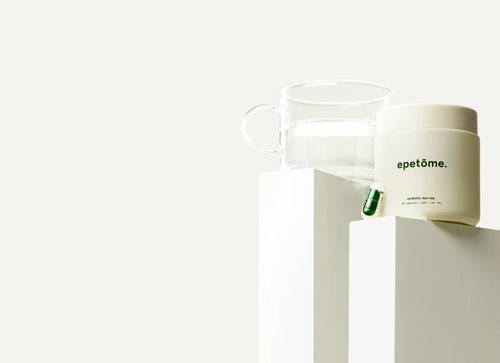
Introducing a high-quality synbiotic such as Epetōme before winter can support the microbiome by building resilience, which in turn supports immunity during the colder months.
Alongside that, certain nutrients are particularly important. Vitamin D supports immune signalling and gut barrier integrity. Zinc plays a vital role in immune defence and tissue repair.
The gut microbiome takes time to adapt to dietary changes and the introduction of new bacteria. Studies suggest it can take up to 90 days for the microbiome to fully adjust. This is why starting in autumn gives your gut the time it needs to strengthen before winter begins.
Additional Ways to Support Your Immunity in Winter
-
Eat warming foods such as ginger, garlic, turmeric, cinnamon and cardamom to support digestion and immunity
-
Prepare soups and broths in advance and store them in the freezer for nourishing, easy meals
-
Include herbs and spices such as oregano, thyme and rosemary, which support the immune system
-
Eat enough protein to maintain energy
-
Eat a variety of colourful fruits and vegetables to provide diverse fibres and antioxidants
-
Exercise to support circulation and gut motility
-
Prioritise quality sleep, as gut microbes respond to the body’s circadian rhythm
Conclusion
Your gut plays a significant role in how well your body copes with seasonal changes. By strengthening your microbiome through a synbiotic, nutrient-rich foods and supportive lifestyle habits, you can build a more resilient foundation for your health before winter sets in. Preparing now allows your gut the time it needs to adapt, so you can face the colder months with greater strength and balance.
References
Hylander, B. L., & Repasky, E. A. (2019). Temperature as a modulator of the gut microbiome: What are the implications and opportunities for thermal medicine? International Journal of Hyperthermia, 36(SUP1), 83–89. https://doi.org/10.1080/02656736.2019.1647356
Isbill, J., Kandiah, J., & Kružliaková, N. (2020). Opportunities for health promotion: Highlighting herbs and spices to improve immune support and well-being. Integrative Medicine (Encinitas), 19(5), 30–42. https://www.ncbi.nlm.nih.gov/pmc/articles/PMC7815254/
Lungaro, L., Malfa, P., Manza, F., Negrelli, M., Costanzini, A., Squarzanti, D. F., Lo Re, M., Cariani, A., Ghisellini, S., Caputo, F., De Giorgi, A., Mansueto, P., Carroccio, A., De Giorgio, R., & Caio, G. (2025). Clinical efficacy of probiotics for relieving cold symptoms in healthy individuals: A randomized, double-blind, placebo-controlled clinical trial. Nutrients, 17(9), 1490. https://doi.org/10.3390/nu17091490
Zhou, E., Zhang, L., He, L., Xiao, Y., Zhang, K., & Luo, B. (2024). Cold exposure, gut microbiota and health implications: A narrative review. Science of The Total Environment, 916, 170060. https://doi.org/10.1016/j.scitotenv.2024.170060

Your gut barrier isn’t a broken pipe. Learn what “leaky gut” really means, how the gut lining works, and simple ways to support it every day.


Your gut and immune system work as a connected team, with beneficial microbes helping your body recognise threats, stay calm around everyday exposures, and maintain balance. By nourishing your gut with prebiotics, probiotics, and fibre-rich foods, you can strengthen your natural defences, reduce inflammation, and support a more resilient immune response.

Winter puts extra pressure on your immune system. Discover the key nutrients that help your body stay strong, energised, and resilient all season.
